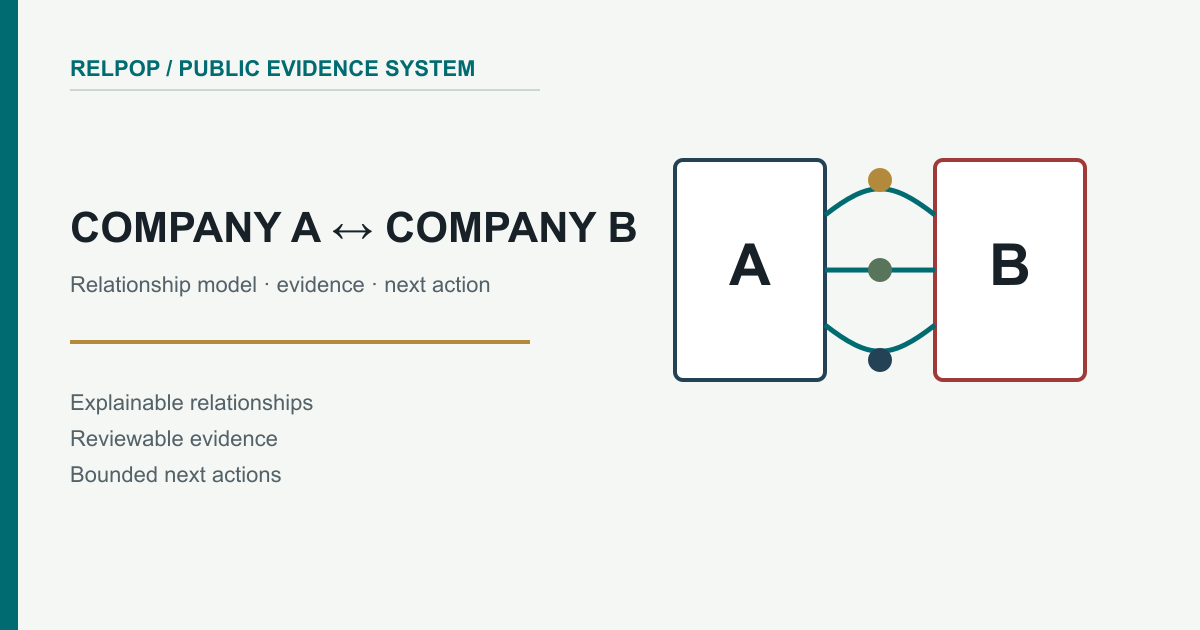
Company matching is not a reordered company-database search. It is a reviewable judgment system that connects business goals, relationship types, evidence trails, and next actions.
The question the system must answer
Company A usually does not need more company names. It needs Company B candidates worth contacting, validating, and investing sales or partnership resources in. A useful output explains why a candidate deserves attention, where the evidence came from, what risks remain, and how the next validation should happen.
Four-layer structure
The first layer is the object model: Company A, Company B, opportunity, relationship, evidence, and action. The second is relationship recognition across purchasing demand, tenders, supply chains, peer substitution, policy opportunities, and regional industry chains. The third records source, time, evidence summary, relationship path, and uncertainty. The fourth turns the judgment into contact priority, validation questions, and risk notes.
Why explainability matters
In sales and partnership work, black-box scores can assist sorting but cannot support action by themselves. Teams need to know which signals triggered a recommendation, whether the signals are current, whether they can be checked, and where the failure modes are. Explainability lowers the cost of a wrong judgment.
Minimum viable delivery
The first version does not need a full platform. Start with one clear Company A and one target Company B scope, then produce 5 to 20 explainable results. Each result should state its reason, evidence summary, confidence, risk, and next action. Only after that small sample proves useful should the work expand to monitoring, graphs, and agent workflows.
Scenarios worth validating first
- You have product capabilities but do not know which companies merit priority outreach.
- You want to enter a region or industry chain and need anchors, partners, and concrete opportunity paths.
- You have public information and internal leads but lack one evidence trail and judgment template.
- You need to turn market intelligence, projects, policies, and company data into sales or partnership actions.